Difference Between MLA 8 and MLA 9 Citations
Detailed comparison of MLA 8 vs MLA 9 citations. Learn what changed, what stayed the same, and how to convert older MLA 8 references to MLA 9.
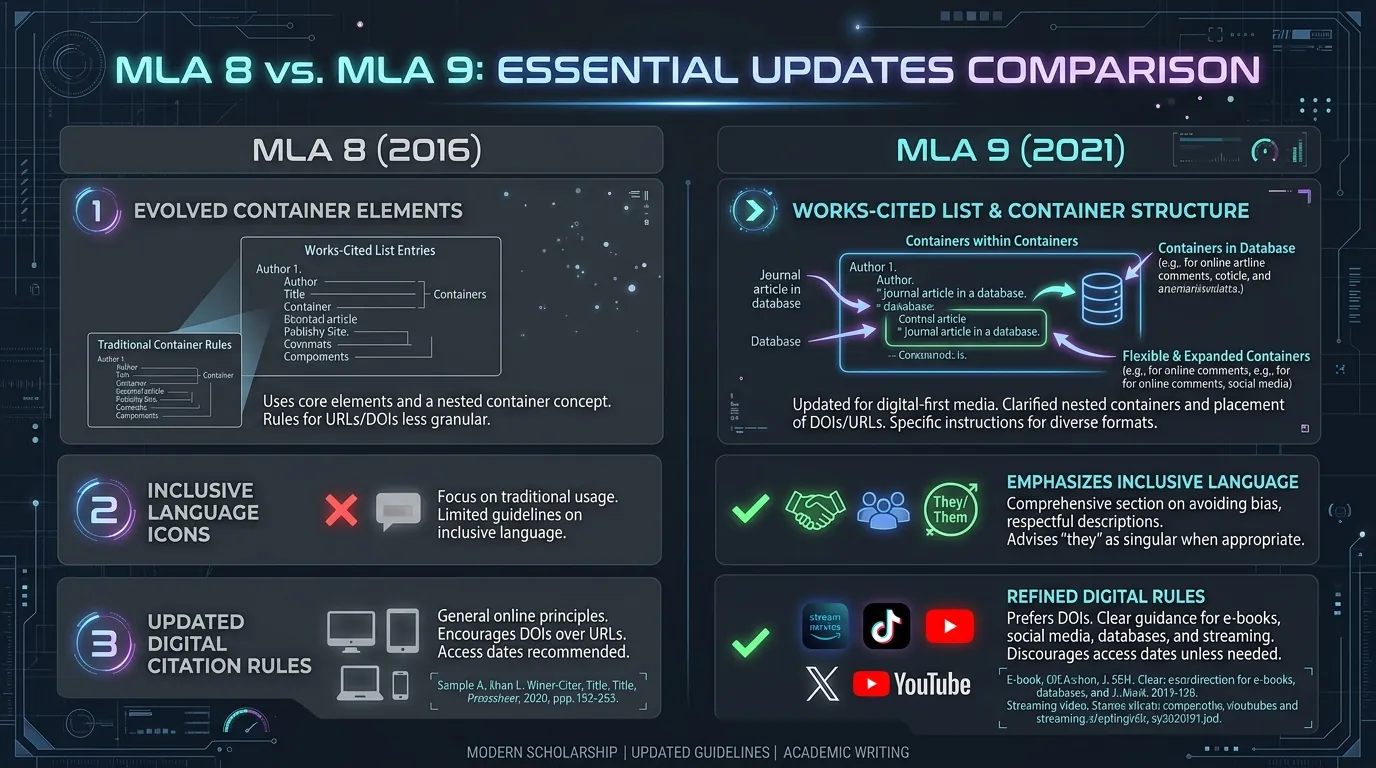
You may stumble on old guides, class notes, or generators that still follow MLA 8. Meanwhile, your teacher likely expects MLA 9. So what really changed? Good news: the core system stayed almost identical. This guide explains the difference between MLA 8 and MLA 9 in plain words. You’ll learn what’s new, what stayed put, and how to update MLA 8 citations to MLA 9 quickly.
What Changed Between MLA 8 and MLA 9?
The MLA released the eighth edition in 2016. The ninth edition arrived in 2021. MLA 9 didn’t rebuild the citation model. Instead, it deepened the guidance and added far more examples.
It also added whole new chapters. These cover inclusive language, paper formatting, and notes. In short, what changed in MLA 9 is mostly depth, not structure. The table below sums it up.
| Area | MLA 8 | MLA 9 |
|---|---|---|
| Core elements | Nine elements | Same nine elements |
| Containers | Introduced | Kept, with more examples |
| Inclusive language | Little guidance | Full chapter |
| Paper formatting | Brief | Detailed chapter |
| Notes | Limited | Expanded guidance |
| Examples | Fewer | Many more |
How Did the MLA 9 Updates Affect Citation Guidance?
MLA 9 made difficult cases much clearer. It explains more about sources with several containers. It also gives stronger advice on missing and optional elements.
For instance, MLA 9 clearly recommends access dates for undated web sources. It also covers more modern formats, like social media and apps. These MLA 9 guidelines help students tackle new sources calmly.
What Stayed the Same Across MLA 8 and MLA 9?
The core model stayed firm. Both editions use nine core elements. Both rely on containers. Both use “et al.” for three or more authors.
In-text citations didn’t change either. You still pair the author with a page, like (Shaw 18). So most MLA 8 citation format entries already look nearly identical to MLA 9 citation format entries.
MLA 8 vs MLA 9 Citations on a Works Cited Page
A basic book entry looks the same in both editions:
Shaw, Nina. Desert Rivers. Canyon Press, 2020.
This example shows why MLA 8 vs MLA 9 citations rarely need major edits. The format you learned still works.
How Do MLA 8 and MLA 9 Differ in Their Treatment of Sources?
MLA 9 adds richer detail for specific sources. It offers better help for works found in databases and apps. It also expands advice on media and online content.
Both editions value flexibility. However, MLA 9 explains when optional elements add real value. That makes MLA 9 citation rules easier to apply to unfamiliar sources.
What Changes Should You Look For When Updating Older MLA Citations?
Watch for leftovers from even older editions. MLA 7 used “Web.” and “Print.” as medium labels. MLA 8 dropped both. If you spot them, delete them.
Next, check dates and descriptions. Add access dates to undated pages. Give untitled works a short description. These steps help you update old MLA citations and match current MLA citation format.
How Can You Tell Which MLA Edition Your Citation Follows?
Check the guide or tool you used. Most list the edition in their title or settings. A guide written before 2021 probably follows MLA 8.
Clues also hide inside entries. “Web.” or a city before the publisher suggests MLA 7. A plain entry with containers suggests MLA 8 or 9. This quick scan helps you check which MLA edition you are using.
What Older MLA 8 Practices Can Cause Confusion Under MLA 9?
Oddly, most confusion comes from MLA 7 habits, not MLA 8 rules. Still, MLA 8 guides lack many modern examples. Students may struggle with social media posts or AI chatbot responses.
Case study: Picture a sophomore using an old MLA 8 handout to cite a chatbot answer. The handout has no example at all. She turns to the MLA’s newer guidance instead. That fixes the gap and avoids MLA 8 outdated rules trouble.
How Should Students Handle Sources or Guides Based on Different MLA Editions?
Follow your instructor first. Most American classes now expect MLA 9. If you’re unsure, simply ask. Then stick with one edition through your entire paper.
Avoid blending rules from different guides. Consistency matters more than tiny differences. Choose trusted resources, like the official MLA Handbook or your campus writing center. This keeps your MLA citation compliance strong.
What Should You Do When an Online Citation Generator Uses Outdated MLA Information?
Open the tool’s settings first. Select MLA 9 if it’s offered. If it isn’t, review every entry by hand.
Remove “Web.,” “Print.,” and “n.d.” Fix dates to day, month, year order. Add access dates where needed. These edits help you use MLA 9 instead of MLA 8, even with older tools.
How to Convert MLA 8 to MLA 9 Quickly
Here’s a fast routine you can follow:
| Step | What to Do |
|---|---|
| Check elements | Confirm the nine core elements appear in order |
| Clean labels | Delete leftover “Web.” or “Print.” |
| Add access dates | Include them for undated web pages |
| Describe untitled works | Add short, clear descriptions |
| Compare examples | Match entries against MLA 9 models |
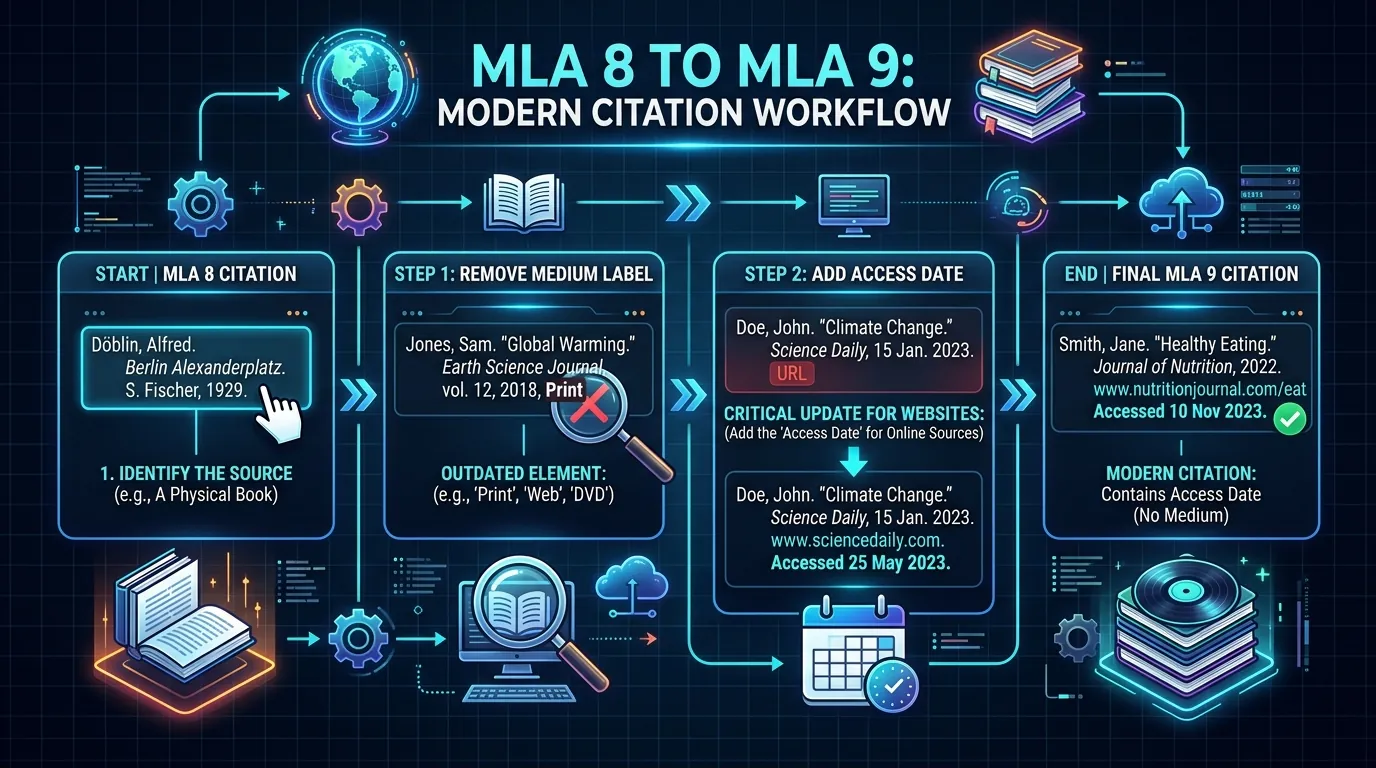
This table shows how to convert MLA 8 to MLA 9 in just minutes.
Conclusion
MLA 9 builds on MLA 8 instead of replacing it. The core elements, containers, and in-text style stayed the same. What grew was guidance, examples, and support for modern sources. To update your work, remove old labels, check dates, and follow one edition throughout. Now you understand the difference between MLA 8 and MLA 9 and can review MLA citations for MLA 9 with confidence.